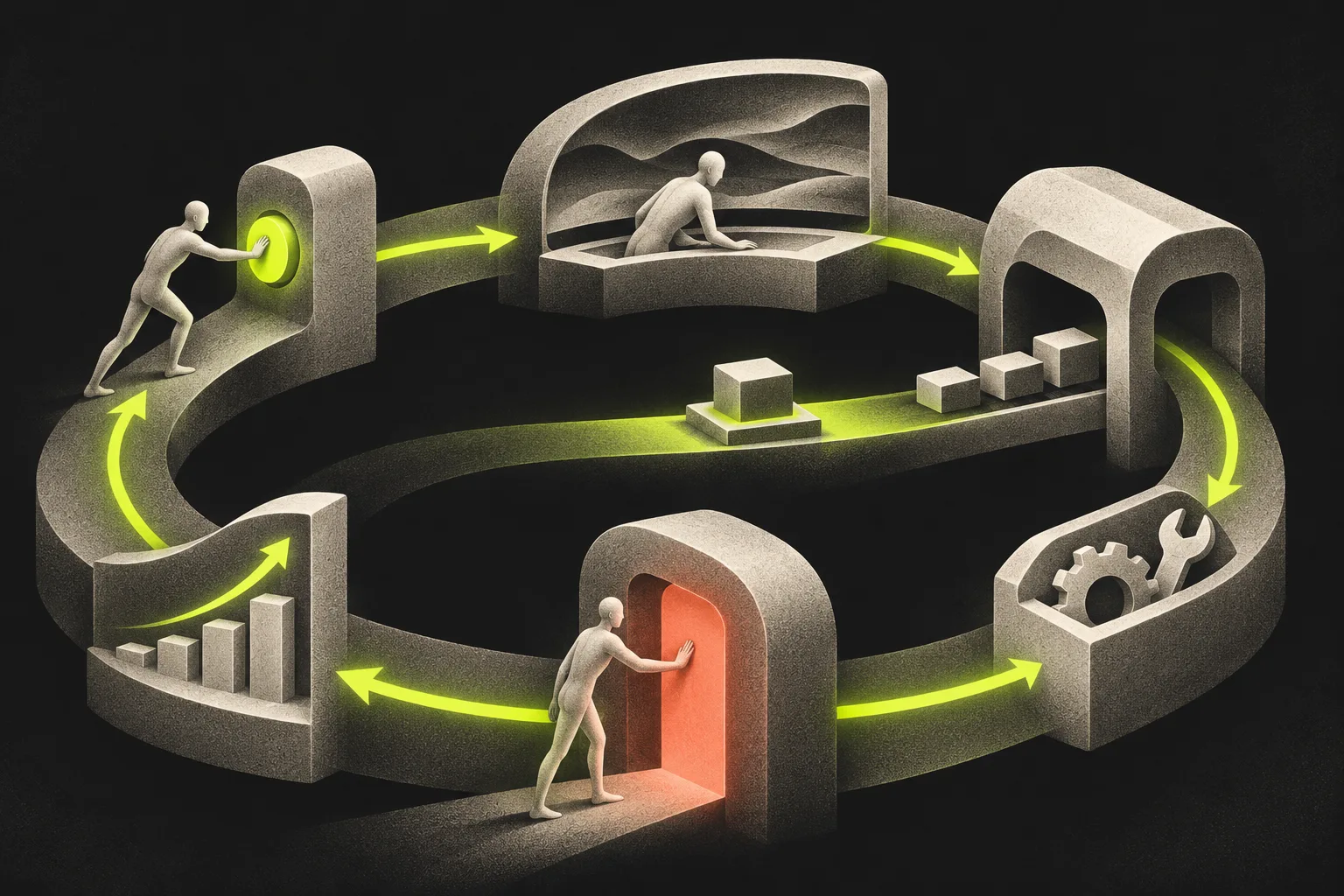
Ask what an agentic system is made of and most answers name the model. That is like describing a restaurant by naming the stove. The stove matters, food comes off it, but nobody books a table for the stove. The same holds here: a deployed agentic system is a loop with six parts, and the model is only one of them. Most of the work, and most of the value, sits in the parts around it.
What are the six parts of a deployed system?
- Trigger. Something starts the work: a new lead, a stalled quote, a renewal date, a usage drop. Nobody has to remember to ask, which is the part that separates a system from a very good suggestion box.
- Context. The system pulls what it needs from your records, history, and rules before it decides anything. Context quality is where most deployments quietly win or lose; a model acting on thin context produces confident generalities about your specific business.
- Decision. It chooses the next step against a goal and a written policy, not against a free-form guess. The policy is text someone owns, which means it can be reviewed, argued with, and improved.
- Action. It does the work in your real tools: sends, books, updates, routes. The action lands where the business lives, so the result is finished work rather than a recommendation about work.
- Check. It verifies the result and retries or escalates when something is off. This is the part hobbyist builds skip, and it is the difference between a system and a confident loop.
- Log and measure. Every step is recorded, so a person can audit it and the outcome can be counted. If the log is an afterthought, neither trust nor improvement is possible.
Ordinary actions flow straight through the loop. Anything high-risk waits at a gate between decision and action, and a failed check sends the work back for another attempt or up to a person.
Where does the human sit?
At the gate, and only at the gate, by design. Where a mistake would be costly or hard to undo, a human approval step sits between the decision and the action: refunds above a threshold, emails to strategic accounts, anything that touches contracts. The gate is not permanent decoration. It loosens as the record of correct decisions grows, and tightens when the record argues for it. That progression, gate to sampled review to exception-only, is how a deployment earns autonomy instead of demanding it on day one.
The placement matters as much as the existence. A human reviewing every action is a chatbot with a rubber stamp. A human reviewing nothing is an incident waiting for a calendar slot. The designed middle, gates on the irreversible classes, logs on everything, is the only version that survives contact with real operations.
Why do identical models produce different results?
Because quality lives in the assembly, not the engine. CrewAI's 2026 survey found 57 percent of executives prefer to build agentic systems on existing tools rather than from scratch, which means the differentiator is not who owns exotic infrastructure. It is who assembles context well, writes policy clearly, checks honestly, and measures without flinching. Two teams can run the same model against the same workflow and produce systems separated by a year of reliability, in the same way two kitchens with the same stove produce very different dinners.
This is also the frame for evaluating a build. Ask to see the loop: where does context come from, who wrote the policy, what does the check verify, what does the log capture. A team with answers has a system. A team with only a model has a stove.
What this is not
It is not a chat window with integrations bolted on. A window waits; a loop triggers, acts, and reports. It is not fire-and-forget either. The loop's outputs get sampled, its gates get tuned, and its policy gets edited, which is why deployments improve while demos age. And it is not exotic: every part above is ordinary engineering. The discipline of assembling them, and running them live, is the scarce thing.
The move
Take one workflow you want to automate and draw its six parts on one page. Two gaps will usually surface immediately: the trigger nobody owns (work starts only when someone remembers), and the check nobody defined (done is whatever felt done). Fix those two before touching any tooling, because a loop with no trigger and no check is not waiting for a model. It is waiting for a design.
Take-home
- Draw the six-part loop for one candidate workflow and name what is missing. Most workflows are missing a trigger and a check, not intelligence.
- Write the policy for the riskiest action in that workflow: what the system may do, what it must ask for, what it must refuse.
- Insist on the log from day one. If you cannot audit last week, you cannot improve next week, and nobody should trust you with volume.
FAQ
Which of the six parts is hardest to build well?
Context, consistently. Tools and triggers are plumbing, and checks are discipline, but context requires deciding what the system needs to know and keeping that picture current. Teams that skip it ship systems that sound smart and act generic.
How many approval gates should a first deployment have?
More than feel comfortable, then fewer as the record earns it. Start with gates on every irreversible or high-value action class, sample-review the rest, and loosen against evidence monthly. Autonomy is granted by the log, not requested in the kickoff meeting.
Does the loop need an agent framework?
No. The loop is an architecture, not a product purchase. Some deployments run on an agent framework; others are ordinary services calling a model at the decision step. Choose by failure modes and auditability, not by which category sounds current.
How does this relate to measuring ROI?
The log is where ROI comes from. Every completed loop counts toward cost per outcome and revenue influenced, the five numbers covered in [part nine of this series](/insights/capital-in-capacity-out). No log, no measurement; no measurement, no investment case.