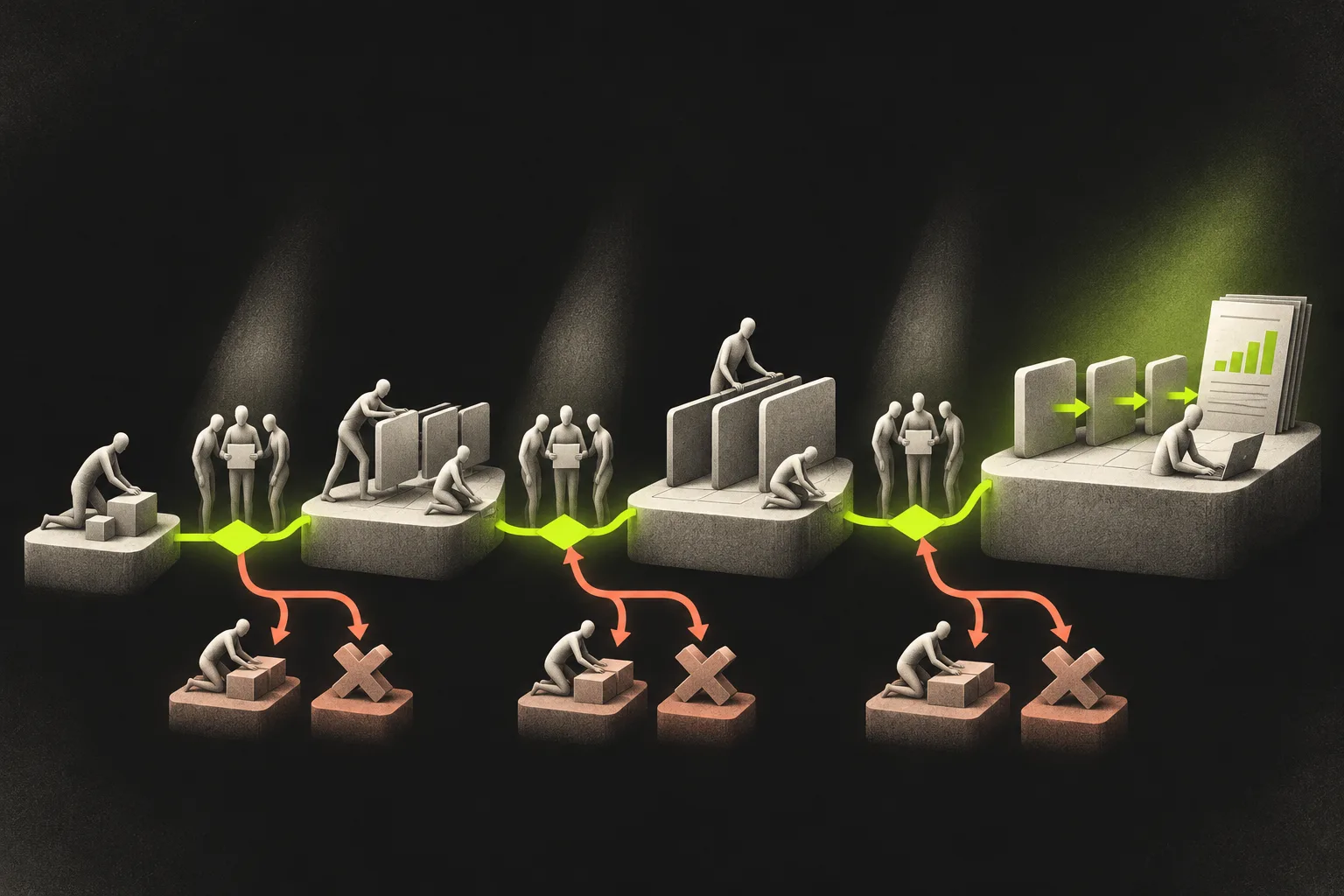
Ninety days sounds long until you count what it contains: one workflow, four phases, four decisions you get to make, and a one-page report every week telling you which of them is coming. A deployment earns trust on a schedule, and the schedule has gates: a gate is a point where you decide to continue, adjust, or stop, against a number both sides agreed on before the work started. Gates are what separate a plan from a pilot that drifts.
This is the last part of the series, and it is the practical one: what actually happens after the arithmetic from part one says the gap is real.
What happens in the first ninety days?
- Find the leak (days 1 to 14). We list the work being left undone, price it with the three questions from part one, and choose one workflow. Gate: an agreed baseline and one target metric.
- Deploy one system (days 15 to 45). It goes live in your real tools with human approval gates switched on, in the six-part loop described in part six. Gate: it handles real volume with no unreviewed high-risk actions.
- Prove it (days 46 to 70). We compare against the baseline every week. Gate: a measured gain that you and your finance lead both accept.
- Expand (days 71 to 90). We choose what to turn on next from the numbers, loosen gates where the record supports it, and set next quarter's targets. Gate: a written plan for quarter two, or an honest stop.
Each gate is a real decision, not a formality. Stopping at a gate with the baseline intact is a good outcome, not a failure; it means the leak was smaller than it looked, discovered for the cost of two weeks instead of two quarters.
What does the deployment need from you?
Three things, and the third is where most engagements stall: access to the relevant systems, one named owner on your side, and one metric you care about enough to check weekly. The named owner is not a project manager. They are the person with authority over the scope document and the gates, and if they cannot make decisions without a committee, the committee should be introduced in week one, not week eight.
In return, the engagement should produce, weekly: a one-page report against the baseline, the full audit log, and the gate calendar with the decision each gate requires. Nothing in that list is exotic. The purpose of the shape is that nothing important is invisible, which is what makes the stop decision at each gate honest.
Why start small on purpose?
Because the businesses that treat revenue capacity as something they can add on demand out-execute the ones that treat AI as a feature to trial, and the treatment starts with a small, proven loop rather than a broad rollout. A first deployment carries three costs that scale badly if you front-load them: integration, evaluation, and the attention of your own team. Spreading those costs across one workflow buys a working proof; spreading them across five buys five half-proofs and a skeptical finance lead.
The expansion mechanic, once the proof exists, is the quiet advantage. Gates loosen where the record earns it, the next workflow inherits the working loop, and the second deployment is faster and cheaper than the first in the way that only accumulated operating evidence makes possible.
What this is not
It is not a pilot. Pilots answer "is the technology capable"; this plan answers "is this capacity earning inside your operation," and it ends at gates with real stop options. It is not a black box either: every phase has named evidence, and the logs belong to you. And it is not ninety days of consulting theater, because the report is one page and the metric is one number; volume of documentation is how projects hide from their own baseline.
The move
Bring last quarter's unworked leads, quotes, or renewals to a thirty-minute conversation, with the arithmetic from part one already done. The first two weeks of phase one are that same exercise done together, so arriving with your half of it starts the clock early. If the numbers say the gap is small, you will have spent thirty minutes confirming your operation is tighter than most, which is a fine outcome too.
Take-home
- Choose the one metric you would actually check every Friday, and name the owner who has authority over it.
- Draft the gate calendar before any kickoff: four gates, four dates, the decision each one requires.
- Do the unworked-work arithmetic now, before the first meeting. Everything downstream of phase one depends on that number being real.
FAQ
What if the first gate says stop?
Then the arithmetic was wrong or the leak was smaller than it looked, and you learned it for the cost of two weeks. Stopping at a gate is the plan working, not failing; the failure mode is a pilot with no gates, which can only end by embarrassment rather than decision.
Why ninety days rather than a longer roadmap?
Because one workflow, measured weekly, either earns or does not within a quarter, and extending the timeline before proof is how small leaks become large consulting engagements. Longer horizons are fine after the first proof, when expansion decisions inherit evidence instead of hope.
Who picks the metric, us or the deployment team?
You do, with the deployment team's honesty about what can be measured cleanly. The metric must be yours because the gates are yours; a metric chosen by the builder is a grade sheet, not a contract.
What happens after day ninety?
Quarter two runs the same shape against the next workflow, with gates loosened where the record supports it and the first deployment's loop reused. The calendar does not change; the evidence base underneath each gate does.
Related reading
- You Are Buying Revenue Capacity, Not a Tool
- Anatomy of a Deployed System
- Governance Is the Moat
- Capital In, Capacity Out
- The Forward Deployed Engineer: Mastering AI Deployment in the Real World
- Build the Snapshot Before the Dashboard
If you have the arithmetic ready and want to size the gap together, book a discovery call. Bring one quarter of unworked work.