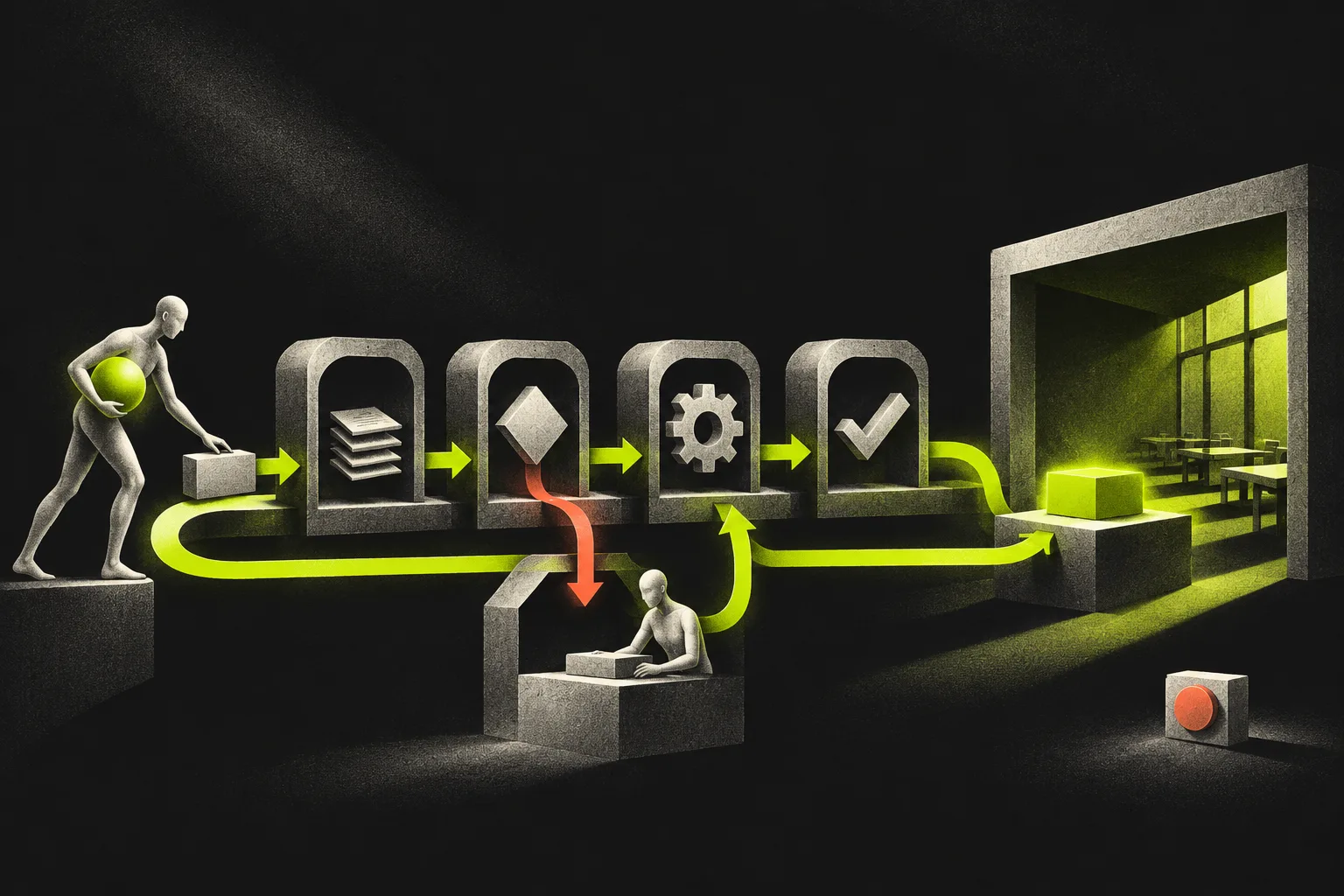
A lead fills in your form at 11 p.m. By morning, someone on the team has an assistant tab open, pastes the inquiry, gets a nicely drafted reply, edits it, looks up the contact history manually, and sends it at 10:40 a.m. Eleven hours for what took the machine four seconds of thinking and the human forty minutes of copying. Now change one thing: nobody opens the tab. The system reads the form, checks the records for history, judges fit, sends a personal reply within minutes, books a slot on the right calendar, logs everything, and flags the strategic accounts to a person. The first version produced an answer. The second produced a booked meeting.
An agentic system is one that holds a goal, decides its own next step, uses your real business tools, and keeps going until the job is done or a person is needed. A chatbot answers. An agent finishes. The whole commercial difference between the two categories hides inside that sentence.
What does an agent do that a chatbot cannot?
An assistant waits for a question, replies, and stops. Its unit of output is a response, and its quality is measured in plausibility. An agentic system's unit of output is a completed task, and its quality is measured in outcomes: meetings booked, quotes chased, renewals flagged, tickets closed.
The difference is structural, not a matter of degree:
- Goal-driven. It works toward an outcome across many steps, not toward a good reply to one prompt.
- Tool-using. It acts in your real systems of record: CRM, inbox, calendar, billing. The action happens where the business lives, not in a chat window beside it.
- Self-checking. It verifies its own work, retries when a step fails, and knows when evidence is too thin to continue.
- Accountable. It keeps a log a person can audit after the fact, which is what makes trust possible at all.
A chatbot with memory and a nice interface still fails every one of the four, because it was built to converse. That is why bolting a chat surface onto a product does not make it agentic, and why the reverse, giving an agent a chat window, changes almost nothing about what it can do.
Why answers without action leak revenue
An answer only has value if someone acts on it, and most revenue leaks live in exactly that gap: the lead nobody called, the quote nobody chased, the churn signal nobody watched. The insight existed in every one of those cases. It sat in a report, a dashboard, a flagged row, waiting for a person with a free hour who did not exist.
Outreach's 2026 guidance describes the same shift from the sales side: the leading teams deploy agents that generate pipeline, flag at-risk deals, and coach reps, treating AI as an execution engine rather than a reporting layer (vendor-reported, as Outreach sells the category). The wording deserves attention. Reporting layer and execution engine are not two flavors of the same product. One tells you what happened; the other makes more of it happen.
What this is not
It is not autonomy without policy. An agent that acts freely in real systems is a liability, and the controls that make action safe, scope, gates, audit, are the subject of part seven of this series. Capability without governance is how this category earns its bad headlines.
It is also not robotic process automation. RPA follows a script through fixed UIs and breaks when the screen changes. An agent decides steps against a goal and a written policy, which is what lets it handle the case the script never met. And it is not a chatbot that "also has tools." Tool access without goals, checks, and accountability produces confident wrong output at industrial scale, a failure mode this archive has covered in confident wrong output marked done.
The move
Audit last week's decisions for the answer-to-action gap. List what your reporting produced: leads scored, deals flagged, churn risks named. Then count how many became an action a customer or a prospect actually experienced. That ratio is the value of your current stack, honestly measured.
Pick the one loop where the answer already exists and the action reliably fails to happen. Closing that loop end to end, reply sent, meeting booked, record updated, is the smallest complete demonstration of what agentic means.
Take-home
- Run the answer-to-action audit on last week's reports. Expect the ratio to be uncomfortable, and record it as the baseline.
- Rewrite one recurring workflow as a goal ("every inbound lead gets a fitting reply within ten minutes") instead of a task ("draft replies when asked").
- Before calling any product agentic, check the four traits. No self-checking and no audit log means it is a chatbot in a trench coat.
FAQ
Can a chatbot become an agent with enough plugins?
Not really. Plugins give a chatbot hands, but goals, self-checks, and accountability are architecture, not accessories. You can extend a conversational product toward agency, but the work is in the loop around the model, not in the model or the window.
Does agentic mean fully autonomous?
No, and mature deployments are deliberate about where humans sit. High-value or irreversible actions pass through approval gates; everything else runs. Autonomy is a dial the operator sets per action class, not a badge the product wears.
What happens when an agent gets stuck?
A well-built one stops and says so. Knowing when evidence is too thin to continue is part of being self-checking. The escalation path, who gets pinged, with what context, is designed before launch, which is what separates an agent from a very confident loop.
Is this only useful for sales?
The pattern applies anywhere work waits on attention: support queues, onboarding checklists, renewal motions, collections. This series follows revenue because the loop from signal to money is shortest there, which makes the results easiest to measure.